
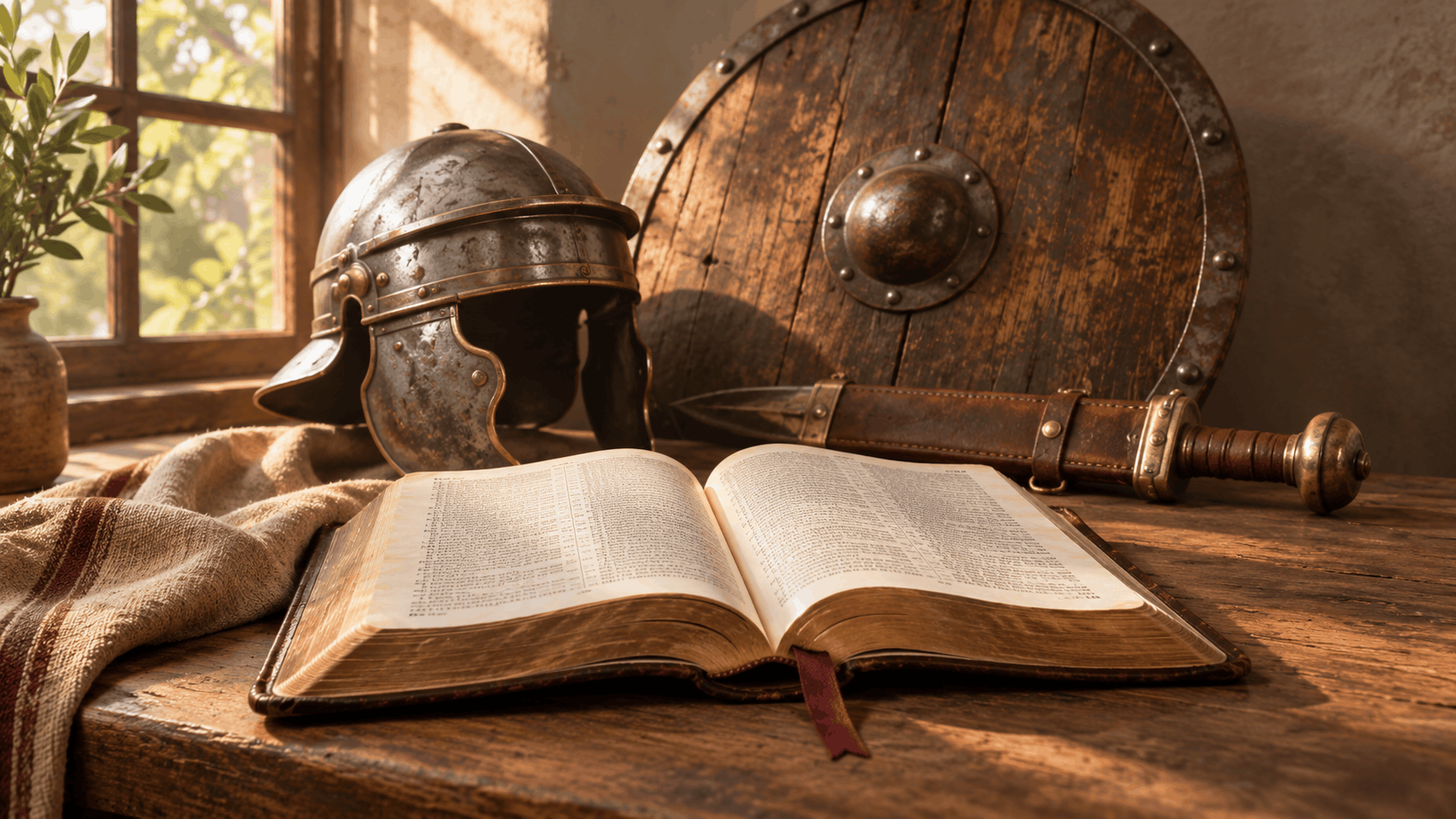

You may know the picture of a shield, a helmet and a sword, yet still wonder what putting on the armor of God looks like on an ordinary morning. How does a passage about spiritual battle help when you’re answering a difficult message, facing disappointment or trying to make an honest decision?
Paul’s explanation begins with where strength comes from. Ephesians 6:10 directs believers to God’s power. From there, he describes a life shaped by what God provides. We can approach the passage with a simple question. How might trust in God change the next choice I make?
What is the armor of God?
Ephesians 6:10–20 uses military equipment as a picture of spiritual readiness. Paul repeatedly urges believers to stand. The six familiar pieces appear in verses 14–17, followed by an extended call to prayer in verses 18–20.
The imagery also has roots in the Old Testament. Isaiah 59:16–17 describes God acting to bring salvation, wearing righteousness as a breastplate and salvation as a helmet. That connection helps us read the armor as God’s provision for his people.
Paul also places a boundary around how readers understand the struggle. In Ephesians 6:12, he locates it beyond human opponents. When applying the passage to a disagreement, keep the other person’s humanity in view. A colleague, neighbour or relative deserves honesty, patience and fair treatment, even when the relationship is difficult.
The six pieces of the armor of God
This table gives the passage’s images alongside a suggested everyday application. The applications are starting points for reflection.
| Piece | Verse | Everyday reflection |
|---|---|---|
| Belt of truth | Ephesians 6:14 | What needs an honest answer today? |
| Breastplate of righteousness | Ephesians 6:14 | What would doing the right thing require here? |
| Readiness from the gospel of peace | Ephesians 6:15 | How can I approach this situation with steadiness and a willingness to seek peace? |
| Shield of faith | Ephesians 6:16 | Where am I being invited to trust God while facing uncertainty? |
| Helmet of salvation | Ephesians 6:17 | How can I remember God’s saving grace when I feel discouraged? |
| Sword of the Spirit, God’s word | Ephesians 6:17 | Which passage should I read carefully before deciding what to do? |
The belt of truth
Begin with something concrete. Perhaps you’ve made a mistake and are tempted to give an explanation that leaves out the awkward part. Practising truth might mean acknowledging what happened, correcting the record and accepting responsibility.
Truthfulness also calls for care with information. Before sharing a striking claim, ask whether you understand it and whether you have grounds to repeat it. A useful daily habit is to pause whenever a story perfectly confirms what you already wanted to believe.
The breastplate of righteousness
A practical response to this image is to examine conduct. Consider the choices that become easy to excuse when you’re tired, annoyed or unlikely to be noticed.
You might return money paid in error, keep a promise that has become inconvenient or stop passing along someone else’s private difficulty. Where you have caused harm, ask what repair is possible. Specific actions give this reflection substance.
Readiness from the gospel of peace
Readiness can begin before a demanding conversation. Take a moment to decide what needs saying and how to say it clearly. Leave room to listen. If you’re writing a reply while angry, draft it and read it again before sending.
Seeking peace may involve a truthful boundary or an uncomfortable discussion. Consider what would help the situation move towards understanding, accountability or a fair resolution. That is often a more useful question than how to win the next exchange.
The shield of faith
There are days when you can’t see how a situation will work out. As a devotional practice, name the uncertainty plainly in prayer. Then identify the responsibility you can meet today.
For example, while waiting for an important decision, you could prepare the information you may need, ask a trusted person for support and set aside a short time to pray. Faith can be expressed through patient, ordinary obedience while the larger outcome remains unresolved.
The helmet of salvation
When reflecting on salvation, allow room for gratitude. Recall the Christian hope of God’s grace, forgiveness and rescue through Christ. You could write a sentence of thanks and return to it when discouragement makes your perspective narrow.
If you need help understanding a question about salvation, take it to someone you trust within your church. A conversation, shared reading and time for questions can help you work through what troubles you.
The sword of the Spirit
Paul identifies this image with God’s word. A useful way to respond is to read a passage slowly enough to understand its setting. Notice who is speaking, who is being addressed and what comes before and after the verse that caught your attention.
Try writing two short notes after reading. First, record what the passage says. Then record a possible response in your own life. Keeping those steps distinct helps you notice when an appealing application needs more thought.
How do you put on the armor of God each day?
Start by reading Ephesians 6:10–20 as a whole. Give particular attention to the move from the armor images into prayer. Paul includes prayer for other believers and asks for courage in his own speaking while imprisoned.
You can use the following approach in a few quiet minutes.
- Name the situation. Choose one concern or responsibility you’re facing today.
- Consider the six images. Use the table to identify one question that fits your situation.
- Choose an action. Make it specific enough to carry out, such as correcting an untrue statement or preparing for a difficult conversation.
- Pray for someone else. Include a person who needs encouragement, wisdom or support.
- Return to it later. In the evening, reflect on what helped and what you need to bring to God again.
Suppose you’ve received a message that feels unfair. You could check the facts before replying, acknowledge any responsibility you bear and explain your concern without exaggerating. You might also pray for the person who sent it. That gives the passage a place in an actual decision.
A prayer based on the armor of God
Father, help me depend on you in the pressures of today. Give me courage to tell the truth and humility to correct my mistakes. Guide my actions towards what is right, and help me seek peace with patience and wisdom.
Strengthen my trust when I feel uncertain. Remind me of your grace when I become discouraged. Give me attention and understanding as I read Scripture, and help me respond faithfully to what I learn.
Bring to mind someone who needs prayer today. Help me offer encouragement and practical kindness where I can. In Jesus’ name, amen.
Continue with a week of prayer
For a simple way to continue, join the Bible Queries mailing list to receive the free 7-Day Stand Firm in Prayer Companion. It includes Scripture readings, short opening prayers and reflection questions, with A4 and US Letter PDFs available after email confirmation. Subscribers also receive occasional Scripture reflections and prayer prompts from Samuel Harris and can unsubscribe anytime.
Get the free 7-Day Prayer Companion
Sources
The explanations above draw on the following passages. Everyday examples and the closing prayer are original devotional applications. Scripture is paraphrased in the article.
- Ephesians 6:10–20 — the armor imagery, standing firm and prayer for others. Read the passage
- Isaiah 59:16–17 — the earlier image of God wearing righteousness and salvation as armor. Read the passage
Frequently asked questions
Where is the armor of God in the Bible?
The main passage is Ephesians 6:10–20. Read through verse 20 to include Paul’s prayer instructions and his request for courage.
Are there six or seven pieces of the armor of God?
Verses 14–17 describe six equipment images. Prayer follows in verse 18, so some teaching outlines include it as a seventh element. Both ways of organising a study should give prayer proper attention.
Can I pray through the armor of God with my family?
Yes. Read a short section together and invite each person to suggest an everyday example. With children, begin with familiar situations such as telling the truth or responding kindly after an argument. Keep the discussion calm and appropriate to their age.
Do I need to use the same prayer every morning?
You can use a written prayer or speak in your own words. A short, honest prayer about the day ahead is a practical place to begin.
Open the signup form if it doesn’t appear above.


0 Comments